Study + Freelancing schedule: a realistic plan
A freelancing schedule that works alongside studying is less about squeezing more into the day and more about deciding what must fit and what can wait. Students who freelance are juggling classes, assignments, exams, freelance projects, and basic life tasks. If the plan is unrealistic, it collapses in the first busy week. If it is simple and honest, it can carry someone through a full semester.
This guide walks through how a student can build a study + freelancing schedule that feels practical, using real-world habits instead of fantasy routines. It draws on the same questions people ask in freelancing schedule reddit threads, freelancer daily routine reddit posts, and searches for freelancing schedule template and freelancing schedule examples, but turns them into something a person can actually follow.
What “realistic” really means for a study + freelancing schedule
A realistic freelancing schedule accepts that energy, not just hours, is limited. A person can block out ten hours on a calendar, but if their brain is finished after six, the extra four will not hold quality work. Realistic planning also respects that study deadlines move through the year: some weeks are light, others are packed with exams and projects.
For a student freelancer, “realistic” usually means:
- the schedule works on an average week, not just a perfect one
- there is room for surprise tasks and delays
- the number of client hours fits the season of study
Many freelancers discover this after trying a brisk schedule that looks impressive on paper and then burns them out in two weeks. A sustainable freelance work schedule leaves space for being human.
Map the fixed parts first: study, sleep, and essentials
Before building a freelancing schedule, it helps to mark the parts that cannot move. These are the anchors.
Classes and labs are fixed points. So are exam slots, key deadlines, and any on-campus commitments. Sleep belongs here too. If sleep is treated like an optional extra, everything else will suffer within days.
A student can treat a calendar as a simple freelancing schedule template and fill it in this order:
First, the essential non-negotiables like sleep and meals.
Next, classes, commuting time if needed, and routine study blocks.
Then, only after that, freelance work blocks, admin time, and personal time.
This order matters. It stops freelancing from quietly taking the place of grades, health, or basic rest.
Know your best working hours
Every person has a natural rhythm. Some do their best thinking early in the morning. Others are sharper in late afternoon or at night when the world feels quieter. A sensible self-employed daily schedule uses those strong hours for the most demanding tasks.
For a student, that usually means deeper work like writing, coding, design, or client projects during peak focus time, and lighter work like email, messages, and simple tasks during lower-energy periods. When freelancing schedule examples sound unrealistic, it is often because they ignore this rhythm and treat every hour as equal.
A freelancer who studies full-time might notice that early mornings are clear and calm before classes, or that evenings after dinner work well for creative work, while the afternoon slump is better for admin or rest.
The core building blocks of a combined day
A day that balances study and freelance work usually has four building blocks: learning time, freelance time, admin time, and recharge time. The exact order changes, but all four belong somewhere.
Learning time covers lectures, reading, problem sets, projects, and revision. Without it, grades slip and pressure climbs.
Freelance time is the focused block used for project work: writing, design, development, editing, research, or whatever service is offered. This is where client expectations are met.
Admin time is often forgotten. It includes reading briefs, sending proposals, answering messages, writing invoices, tracking time, and basic business tasks. It can be short but still needs its own space.
Recharge time is how burnout is prevented. Short breaks, meals, movement, and something that is not a screen give the brain breathing room.
A daily plan that squeezes freelance work and study together with no space for admin or rest will look efficient, but it will quietly drain mental health and productivity.
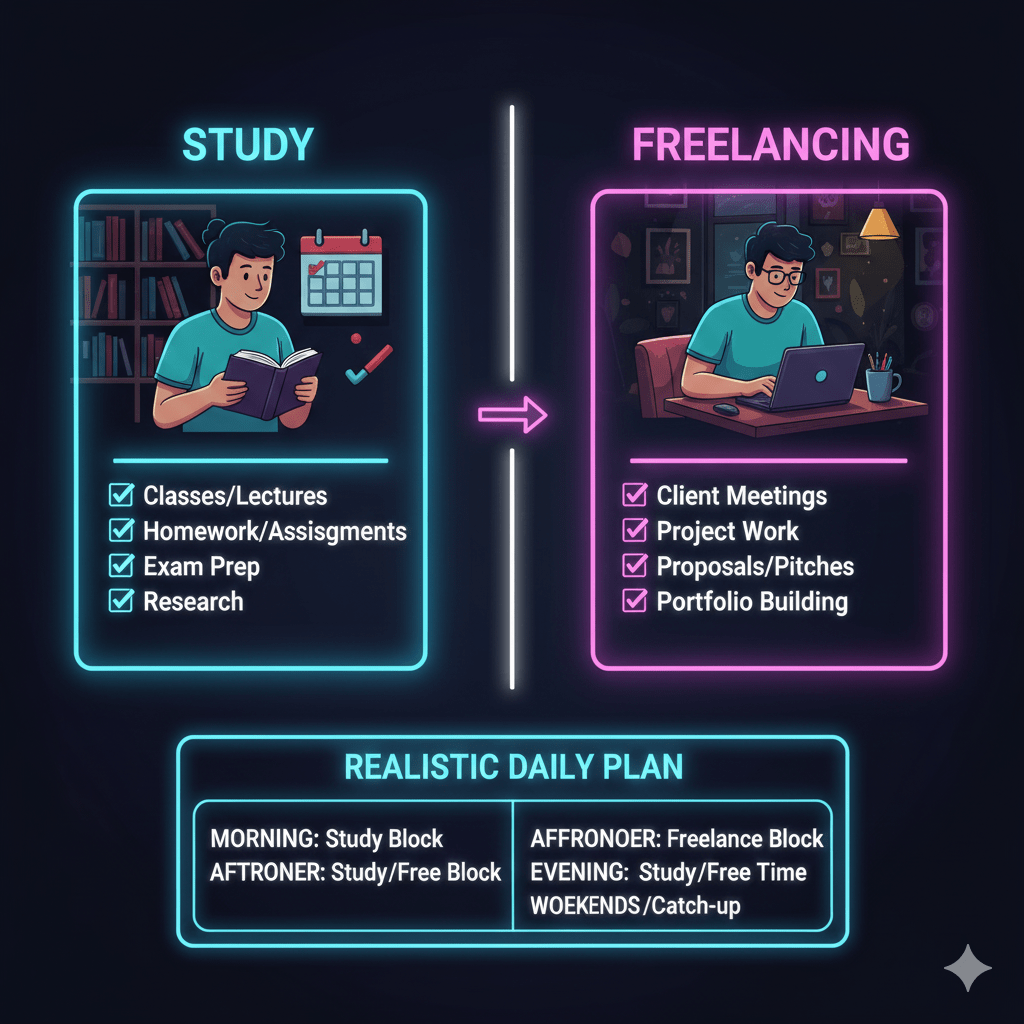
A weekday study + freelancing schedule example
To see how this looks in practice, imagine a weekday for a student who has afternoon classes and some freelance work.
The morning begins with a simple routine and a quick look at a to-do list. From around eight to ten, the student tackles focused study, such as reading, solving problems, or writing assignments, while the mind is fresh. From ten to twelve, there is a client block for freelance work, such as drafting content or making design progress on a live project.
After lunch, early afternoon might be used for classes and lab work. Gaps between classes can hold short admin tasks: checking email, responding to clients, and updating a project list. Later afternoon might be another class or a short review of study notes.
Evening can hold a lighter freelance work block if needed, perhaps one more hour for revisions or finishing a small project. After that, the day shifts toward winding down instead of more heavy tasks, with a small check of the next day’s schedule and a simple note of the top three priorities.
This kind of plan keeps freelance work hours clear, respects class time, and leaves enough space for life outside screens, without turning every spare minute into work.
A weekend schedule that supports both rest and progress
Weekends can either be rescue days or recovery days. For a student freelancer, they often need to be a mix.
On a weekend morning, a student might set aside a two-hour block for one major study focus, such as a group project or exam preparation, and another two-hour block for freelance work on a larger client project. Afternoon could be lighter: finishing small tasks, reviewing the coming week, or preparing a freelancing schedule template for the next seven days.
The key is that weekends are not treated as endless extra work time. A freelance daily life that never includes full breaks will not stay productive for long. At least one half-day, or at certain times a full day, should be kept mostly free from both study and freelance work to protect energy.
Using tools without turning the day into a time-tracking maze
Many freelancers look for an easy app to track time, manage a to-do list, and organize a freelance schedule. Tools can help, but they should be servants, not masters.
A simple setup might be enough: one calendar (for example, Google Calendar) to block out classes and work hours, plus one tool or notebook that holds tasks and deadlines. For some people, a time clock or timer is useful for a while to learn how long tasks really take. Forindividual freelancers, especially those new to freelancing, tracking worked hours briefly can be an eye-opener.
Complicated time management systems, advanced reporting, and heavy project software might be more than a student needs. A light structure that is used daily will do a long way more than a perfect system that feels like extra homework.
How much freelance work fits alongside study?
The right number of hours depends on the person, their course load, and their health. As a starting point, many students manage ten to fifteen hours of freelance work per week during quiet periods and less during exam seasons. Some take on more, but that usually requires strong habits and clear priorities.
A student can experiment with a small freelance work schedule first, adding only a few hours per week and watching how it feels. If energy and grades stay strong, hours can increase slightly. If study time shrinks or stress rises, it is a sign to pause and adjust.
Thinking like this turns the freelancing schedule into a living plan instead of a fixed rule.
Keeping clients in the loop without being online nonstop
Clients do not need a freelancer to be available every minute. They need clarity. A good freelancing schedule includes short windows for client communication and sets expectations about response times.
A student can let clients know their working hours, such as mornings and early evenings on weekdays, and a certain range on weekends if necessary. They can also explain how long it usually takes to respond to messages and when deadlines will be delivered.
This simple communication protects both sides. Clients feel informed; the freelancer can keep deep focus times intact instead of checking messages every few minutes.
Protecting health while juggling study and freelance work
A schedule that ignores health will eventually collapse. Freelance writer routines that never include breaks, movement, or social time often show early success and then a sharp drop.
A balanced daily freelance schedule should include regular meals, some physical movement (even a short walk), and time away from screens. It should also protect sleep as a basic requirement, not a bonus.
Mental health matters here too. Study pressure plus client demands can make a person feel like there is never enough time. A realistic schedule accepts that not everything can happen at once. Some projects will be turned down. Some weeks will be lighter on freelancing to focus on exams. This is not failure; it is good management.
Adapting the schedule during exams and busy seasons
A healthy freelancing schedule understands that the year is not flat. Before exam periods or large assignments, a student should look ahead and reduce client commitments where possible. This might mean finishing certain projects early, pausing outreach for new work, or agreeing on lighter weeks with regular clients.
During those intense seasons, freelance work blocks become smaller and more focused. Instead of taking on new projects, the student concentrates on existing commitments and simple maintenance tasks.
After the busy period, hours can slowly increase again. This ebb and flow is normal in self-employed daily schedule planning, especially for students.
Conclusion
A study + freelancing schedule works best when it is honest, simple, and adjustable. Mapping non-negotiable study and sleep first, placing freelance work in focused blocks, and giving admin and rest their own space turns a chaotic week into something manageable. Tools like a calendar, basic time tracking, and a clear to-do list help, but only when they support habits instead of replacing them.
Many freelancers learn this by trial and error. A student who treats their time with the same care as client work, listens to energy levels, and adapts the plan during heavy study weeks can build a freelancing schedule that supports both grades and income instead of sacrificing one for the other.