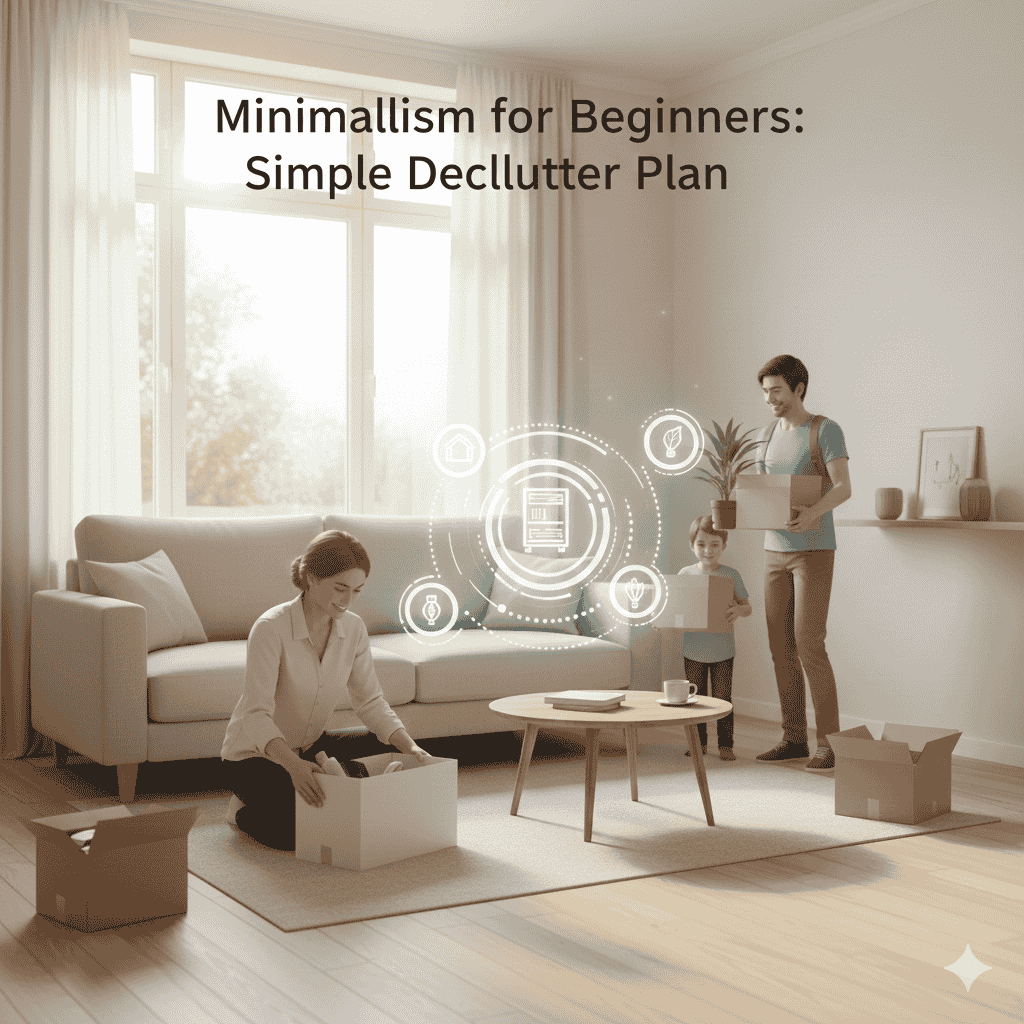
Minimalism for beginners: simple declutter plan
Minimalism for beginners is not about living in an empty white box or owning exactly 100 belongings. It is about gently turning down the noise in your life so that what truly matters has more room to breathe. Instead of chasing more and more things, a beginner minimalist starts asking a different question: “What do I actually need for a simple life that feels good and sustainable?”
Many people first stumble onto this idea through a Minimalism for beginners reddit thread, a blog about a minimalist lifestyle, or a video that shows minimalist living examples from ordinary families. Others arrive here during a difficult time, when the house feels out of control, money is tight, or the mind is overwhelmed. Whatever the path, the goal is the same: less unnecessary clutter, more clarity and peace.
This guide offers a simple declutter plan, written especially for someone who is new to the idea and wants easy tips, not extreme minimalism. It blends Minimalism philosophy with practical steps you can follow at home, without needing to turn your whole life upside down in one weekend.
Understanding minimalism for beginners
Minimalism has many definitions, but for a beginner it can be understood as a lifestyle where your possessions, habits, and commitments are chosen deliberately instead of by accident. Minimalism promotes peace by helping you remove the wrong things so you can see the significant things: relationships, health, meaningful work, and time.
In older books you may see minimalism described almost like an art form, a kind of minimalismthe art of living with less. Modern minimalism for beginners is more flexible. It allows a family house, a full-time job, even a love of certain hobbies, as long as those choices are conscious. The minimalist mindset is not “own nothing”; it is “only keep what supports the life I actually want.”
Minimalism philosophy pushes against a consumerist lifestyle that whispers “buy this and you’ll be happy” every time you feel bored, sad, or stressed. Instead of adding more stuff whenever something feels off, minimalism encourages simple living and honest reflection. It invites you to ask hard questions about why you own what you own, and whether those belongings are still serving you.
This is why there is no single “Best minimalism for beginners” that works for everyone. A student in a small room, a parent in a busy house, and a retired couple will all practice minimalism differently. The key elements are the same, though: fewer possessions, clearer spaces, and more attention on what truly matters.
Mindset before trash bags
Many people who rush straight into decluttering run into frustration. They start filling bags, but halfway through they feel stuck, guilty, or confused. The real first step in any Becoming a minimalist checklist is not the bin; it is the mind.
Take a moment to notice the stories that surround your belongings. A consumerist lifestyle teaches that new items will solve old problems: a new outfit for confidence, new decor for a fresh start, new gadgets for productivity. Over time, this turns into a house full of “maybe someday” objects that quietly drain energy.
Minimalism asks you to slow down and observe. You might walk through your home and simply look at your things without touching anything. Which items do you use almost every day? Which ones have not been touched in months or years? Which objects carry a feeling of heaviness, obligation, or guilt when you see them?
This is not about judging yourself. Many people have bought things they did not need; many people have kept belongings out of fear or habit. Minimalism minimalism in a strict sense is not the only way forward. You can begin with tiny steps and gentle questions:
- “If I moved tomorrow, would I happily pack this, or would I quietly leave it behind?”
- “If I saw this in a shop today, would I spend money on it again?”
- “Does this object add to my minimalist journey, or does it keep me tied to a version of myself that no longer fits?”
When the mindset starts to shift, decluttering stops feeling like punishment and starts feeling like relief.
A simple declutter plan without overwhelm
Now that the foundation is set, you can start a simple declutter plan that fits minimalism for beginners. Think of it as four gentle phases rather than a strict schedule. You can move at your own pace, even if you only have a few minutes each day.
The first phase focuses on visible surfaces. Instead of tearing apart whole rooms, you choose one table, one countertop, or one shelf and clear it completely. Everything is moved away. Then you put back only the items that truly belong there and support your minimalist lifestyle. The rest goes into temporary boxes to be sorted later. This alone can change the feeling of a room and prove to you that small changes make a real difference.
The second phase works by category rather than by room. Clothes are often the easiest starting point because they take up space and reveal a lot about your habits. You might take all your tops, or all your trousers, or all your shoes and gather them in one place. Then you quietly try each piece on and ask the same questions: does this fit, do I wear it, and does it suit the person I am today?
What remains after this honest look can begin to resemble a capsule wardrobe: several clothes that fit, match, and make getting dressed easier. You do not need to count items or follow strict rules; the idea is simply to let go of the items that no longer support your minimalistic life.
The third phase is about creating a minimalist home layout that makes sense. When you decide which items stay, you also decide where they live. Plates are stacked in one cupboard instead of three. Important documents are stored in one safe place. Children’s toys are contained in a single area instead of scattered through the house. When everything has a clear home, tidying takes a few minutes, not a full evening.
The fourth phase introduces gentle rules for new things. Without this, clutter quietly returns. You might set rules such as “one in, one out” for clothes, or a simple pause before purchasing a new item: wait until the next time you go to buy it, and see if you still want it. You can also decide a short list of categories where you are allowed to buy, and treat everything else with extra caution. These small rules help turn decluttering from a one-time event into an ongoing practice of living with less.
Room-by-room: how to become a minimalist at home
When people search for how to become a minimalist at home, they are often imagining specific rooms, not general ideas. Here is how this simple declutter plan can unfold in everyday spaces, without long checklists or pressure.
In the living room, start with what you actually use to live: seating, light, and a few items that bring joy. Many people find that once old magazines, unused decor, tangled cables, and forgotten gadgets are removed, the room feels larger and calmer. The television or entertainment area can also be simplified. Keeping only the devices you truly use and letting go of the rest reduces visual noise and makes it easier for the mind to rest.
The kitchen is another place where unnecessary clutter hides. Drawers full of duplicate utensils, shelves with cracked plates, and gadgets that were used once and then ignored all steal space. A beginner minimalist can go cupboard by cupboard, removing any item that has not been used in the last year, any broken container, any tool with the same function as another. The goal is not to have a perfect minimalist kitchen, but a space where cooking and cleaning take less time and energy.
Bedrooms benefit deeply from minimalism. Clothes piled on chairs, surfaces full of random belongings, and wardrobes packed with several clothes that no longer fit all affect sleep and mood. By reducing clothing to what is actually worn and clearing surfaces, the bedroom begins to support rest instead of stress. A small bedside table, a lamp, and one or two meaningful objects can be enough to create a calm corner.
Bathrooms can often be decluttered in a single session. Old skincare bottles, expired medicines, and travel-size products that never get used all contribute to the sense of chaos. Removing these and keeping only what you reach for in everyday life makes the space easier to maintain. It also reveals when you are tempted to buy yet another product instead of using what you already have.
One area many people forget is digital clutter. A truly minimalist home now includes the screens that live inside it. Unused apps, constant notifications, and full inboxes can weigh on the mind just as much as messy shelves. Setting aside a little time to remove unused apps, unfollow accounts that trigger comparison, and organise key folders on your computer can bring surprising calm.
Money, time, and the hidden benefits of simple living
Minimalism for beginners often begins with objects, but it quickly reaches deeper issues: money, time, and energy. When you practice minimalism and stop buying things you do not really need, the financial benefits can be significant. You may suddenly have room to build an emergency fund instead of living month to month. You may notice that the money previously spent on random purchases can now fund experiences, education, or support for a family member.
Time is also affected. Every possession in a house requires some degree of attention. It must be cleaned, stored, or at least moved when you vacuum. A house weighed down with unnecessary clutter demands more of your weekends. When you own fewer things, you clean faster and you can achieve better work-life balance because your free hours are not consumed by chores.
Minimalism promotes peace by reducing constant decisions. Instead of spending time wondering what to wear from a bursting wardrobe, you reach for clothes you already know you like. Instead of searching for items lost under piles, you find what you need quickly because your belongings have homes. Many people report that their mind feels clearer once their space is simplified, as if the brain no longer has to constantly process all the visual information in a crowded room.
These changes do not arrive in a single day. They build slowly as you make certain adjustments: saying no to a sale, walking past a home decor section, or choosing to repair instead of replace. Over months, these choices add up to a minimalist life that feels more free, not more strict.
Habits that keep your minimalist journey on track
Decluttering once is one thing; staying decluttered is another. The habits you develop after the first round of clearing are what transform a beginner minimalist into someone who lives a sustainable minimalist lifestyle.
One helpful habit is a quick daily reset. This does not mean deep cleaning every evening. It might simply be walking through the main rooms and returning a few items to their places. When clutter is small, it takes only a few minutes to reverse it. This keeps unnecessary clutter from building up into a huge weekend project.
Another habit is pausing before buying. Each time you want to bring a new item into your home, ask yourself if it fits your values and if you already own something that can do the same job. You can promise yourself to wait until the next time you are in that shop, or until you have discussed it with someone you trust. Often the urge fades, and you realise you did not truly want the item, you just wanted to feel better in that moment.
You can also set rules that feel right for you. For example, you might decide that for every new item of clothing you buy, one old piece must leave. This prevents the wardrobe from growing silently. You might limit how many decorative objects each room holds, or decide that digital clutter gets a quick check every Sunday evening. The rules do not need to be complicated; they only need to support the minimalistic life you are building.
Remember that there will be days when the house looks messy again, especially if you live with others. Minimalism is not about never seeing clutter. It is about creating a lifestyle where clutter is easier to clear because there is less of it, and because you now have simple systems for handling it.
Conclusion
Minimalism for beginners is not a contest to prove who owns the fewest objects. It is a gentle invitation to ask whether your belongings, habits, and spaces still match the life you want to live. By making a few brave decisions—letting go of things you no longer need, questioning the urge to buy, and creating a minimalist home that truly supports you—you begin to reclaim your time, money, and energy from the grip of unnecessary clutter.
The simple declutter plan in this guide does not require you to become a different person overnight. It asks only for tiny steps: clearing one surface, choosing which clothes still serve you, deciding where important items live, and setting small rules for what comes in next. With each step, your space becomes lighter, your mind calmer, and your days a little more aligned with what truly matters.
In the end, the best minimalism for beginners is not the strictest or the most impressive online. It is the version that you can sustain, that your family can live with, and that makes your life feel more honest and peaceful. Minimalism promotes peace not because it is perfect, but because it helps you let go of the wrong things so you can give more of yourself to the significant things.